Air Conditioner Peptide Screening Labs Third-party Peptide Evaluation
Confirmed > 99% Lab-grade Peptides
Throughout solid-phase synthesis, each amino acid coupling step has a return of approximately 99-- 99.8%. When a combining fails, the expanding chain is covered to avoid additional prolongation of the incorrect series. The outcome is a peptide that's shorter than planned-- missing one or more amino acids.
- In concentration-response experiments, these impurities can shift contours, squash plateaus, or present biphasic actions that covers real task of the target substance.
- Peptide recognition is mostly carried out using mass spectrometry (MS), which gives precise dimensions of peptide molecular weight.
- It likewise sustains traceability-- each set's laboratory validation record can be connected to its COA and regulative filings, creating a clear proof.
- This degree of detail helps scientists understand if any small peptide by-products are present.
- The chromatographic pureness is after that computed by comparing the area under the primary top with the complete location under all integrated optimals.
- We deal with biotech, pharmaceutical, CRO, CDMO, and academic groups on peptide chemical and physical analyses that support research study and non-clinical decision production.
Frequently Asked Inquiries (Frequently Asked Questions) Concerning Laboratory Recognition In Peptide Study
If you've ever before browsed a peptide directory, you've seen pureness numbers everywhere. These numbers get thrown around so often that it's easy to gloss over them-- just another spec on an item page. Chameleon Peptides offers study substances solely for laboratory and logical functions. All PRG products are meant exclusively for artificial insemination study or further manufacturing use. Using a highly purified peptide minimizes these risks and boosts the integrity of your data.
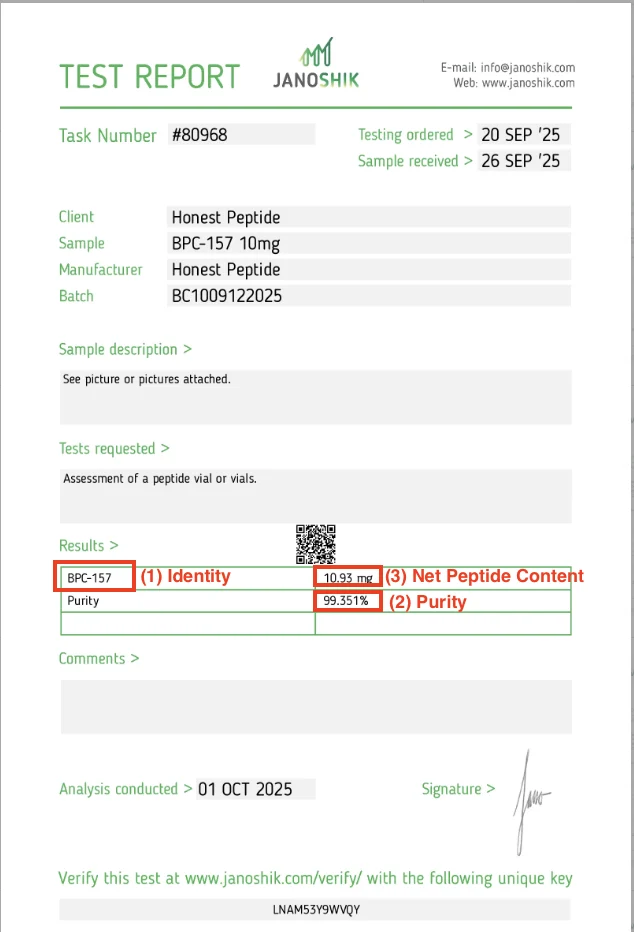
Innovative Peptides suggests a collection of various pureness levels to assist you choose the appropriate peptide pureness for peptide-based assays and applications. The following listing reveals the recommended peptide pureness degrees required for numerous peptide applications. Peptide recognition is mostly executed making use of mass spectrometry (MS), which supplies exact measurements of peptide molecular weight. Furthermore, methods such as amino acid evaluation and HPLC are used to validate the peptide's identification and pureness, guaranteeing exact characterization for numerous applications. We provide peptide identity confirmation using mass-based approaches chosen for the sample and logical objective. This is important when the main question is whether the observed part matches the designated peptide or whether a modification has been integrated as anticipated.Common Purity (≥ 95%)
Lack Of Effective Approaches For Structural Adjustments And Series Verification
The quality and reliability of a peptide purity measurement depend upon method parameters and paperwork quality. The mobile phase, frequently a mixture of water, acetonitrile, and an acid modifier, is kept in storage tanks and provided via the system by a high-pressure pump. The pump keeps specific circulation prices, commonly in the range of 0.5 to 2.0 mL/min relying on the method and column format. High pressure compels the mobile phase with securely loaded bits inside the column, producing sharper splittings up and higher resolution than standard low-pressure chromatography.Maintaining a high level of pureness is crucial since contaminations can influence bioassays or reactions. For example, trimmed peptides or chemically modified side-products could bind to targets or generate negative effects that confound your outcomes. Particularly changed peptides or cyclic peptide series are difficult to validate, which impacts quality assurance. We incorporate LC-MS/MS and chemical food digestion analysis to specifically verify the sequence and alteration sites of non-natural customized peptides. Recurring natural solvents, metal ions, or byproducts from synthesis might cause harmful negative effects.
Either can be appropriate, but third-party testing is the gold criterion for research-grade materials. Residual solvents, such as DMF, acetonitrile, or DMSO, are quantified using gas chromatography (GC) techniques. These solvents can influence peptide functionality, so precise metrology is vital to ensure pureness and stop contamination in experimental settings. Peptide security is analyzed under various conditions to make sure integrity during research and item development. In addition to HPLC and MS, specialized laboratories might utilize orthogonal strategies for included accuracy. For instance, capillary electrophoresis can be made use of to separate very hydrophilic peptides or to double-check outcomes, and MALDI-TOF mass spectrometry can help in mapping larger or modified peptides. Numerous peptide producers or distributors will provide a COA (Certificate of Analysis), for example our bpc 157 tb 500 blend, that consists of the pureness percent by HPLC and identity verification by MS for each batch. Top-tier laboratories frequently report peptide pureness well above 95%, frequently ≥ 98-99%, by using modern HPLC and MS evaluations. They likewise evaluate both basic materials and completed peptide vials, which aids catch any impurities, degradation products, or solution inconsistencies.